THE CLEARANCE PROOF SPRINT
One week, one file, one acceptance test.
You give us one anonymized file. We build the clearance check that finds what is missing or does not match in it, with the source field behind every open item and your reviewer in front of every action. At the end of the week you have a working check, a written never-touch list, and a fixed-price plan for production.
What you give.
A 45-minute kickoff.
One anonymized sample file: purchase contract, commitment, deed, closing disclosure, payoff letter, estoppel, lender closing instructions.
A 30-minute review at the end of the week.
What you get.
A working clearance check on your sample.
Every discrepancy and open item with the source field it came from.
A reviewer step — nothing proceeds without a person.
A written never-touch list.
A production plan with a fixed price and a go-live date.
What it is never allowed to do.
Wires or wire instructions.
Disbursement or release of funds.
Identity or fraud decisions.
Final title or legal judgment.
Any change to a production file without your reviewer.
The proof runs on an exported, anonymized sample: nothing connects to your production system. If you go to production, access is read-only until you approve otherwise in writing. These boundaries go into the contract.
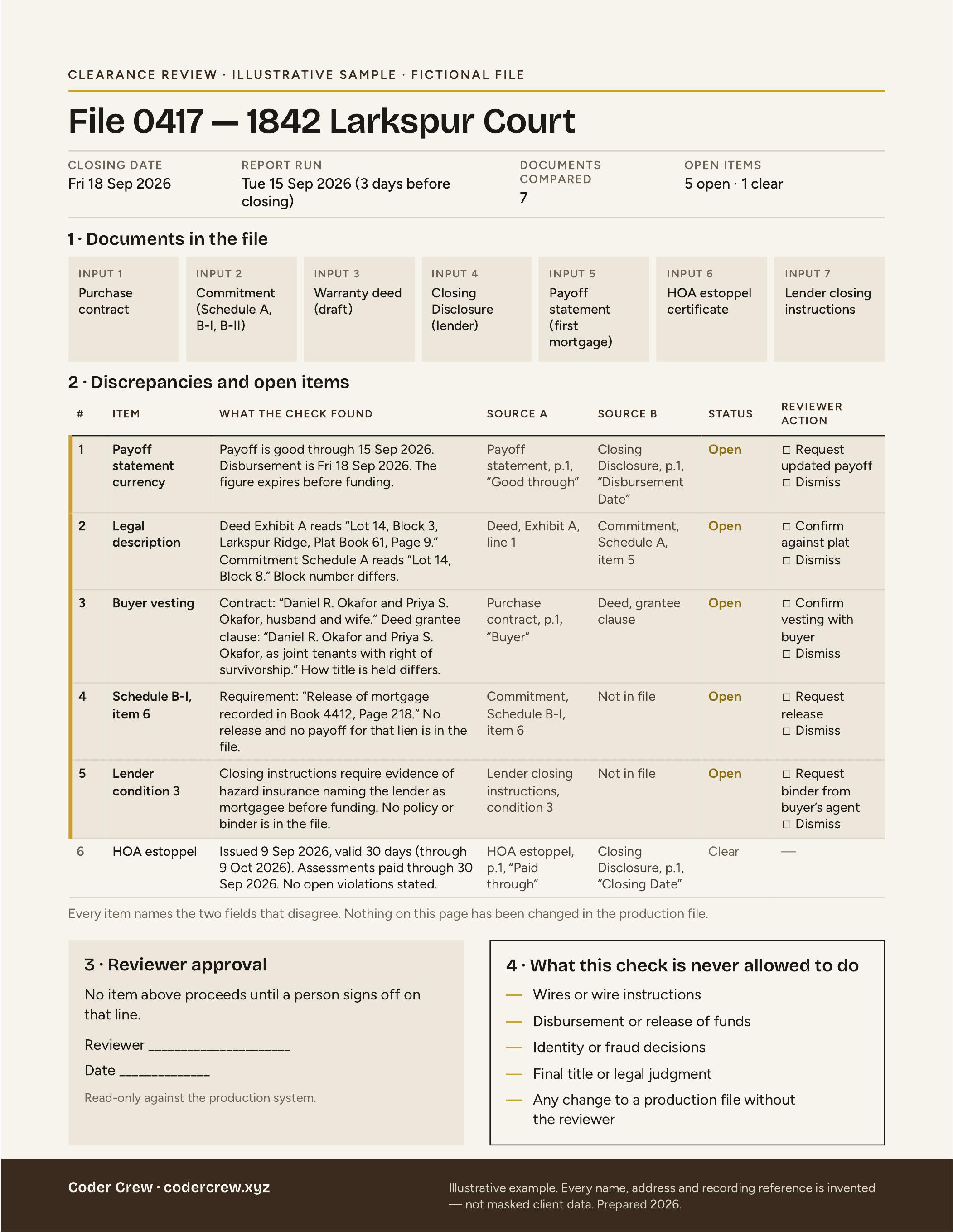
The one-page clearance review.
One page: the input file, each discrepancy or open item, the source field that caused it, the reviewer step, and the never-touch list.
What your vendor review will ask for.
Title work runs on vendor oversight. Before kickoff you get: a data-flow brief naming every system that touches your sample; the access controls on each, with multi-factor authentication on every account that can reach it; how the sample is stored and when it is deleted; and our incident-response plan. Nobody outside Coder Crew works on your file; hosting providers are named in the privacy policy. If your underwriter or your ALTA Best Practices review needs something else — a background-check statement, a questionnaire — ask on the fit call and we complete it.
If the proof fails the acceptance test.
We agree the acceptance test before starting. The fee is one fixed number, stated on the fit call, and refunded in full if the proof cannot pass that test after one cure window of up to five business days.
The acceptance test is written into the proposal before kickoff. A cure window is up to five business days.
Common questions.
- Which production system do you need?
- Any. The proof runs on an exported, anonymized file — nothing connects to your production system and no credentials are needed. In production the check reads from your system where the system allows it and from exports where it does not.
- What counts as anonymized?
- Names, addresses, loan numbers and account numbers replaced or masked; we send a one-page guide before kickoff. Samples are deleted at the end of the sprint, unless you ask in writing to keep them for a production build.
- Can the check catch things that aren't on your list?
- The sprint scopes the check to what actually goes wrong in your files, which is why we ask for a real one.
- Who does the work?
- Mustafa Shaheen leads every sprint. Everyone who touches your file is named in the data-flow brief.
- What happens after the sprint?
- If it passed and you want it in production, you get a fixed-price plan: what runs on every file, what stays read-only, the go-live date in writing, and the price. If not, you keep the findings and we close the file.
Start with one file.
A 15-minute fit call decides whether this is worth a week of your production team's attention.